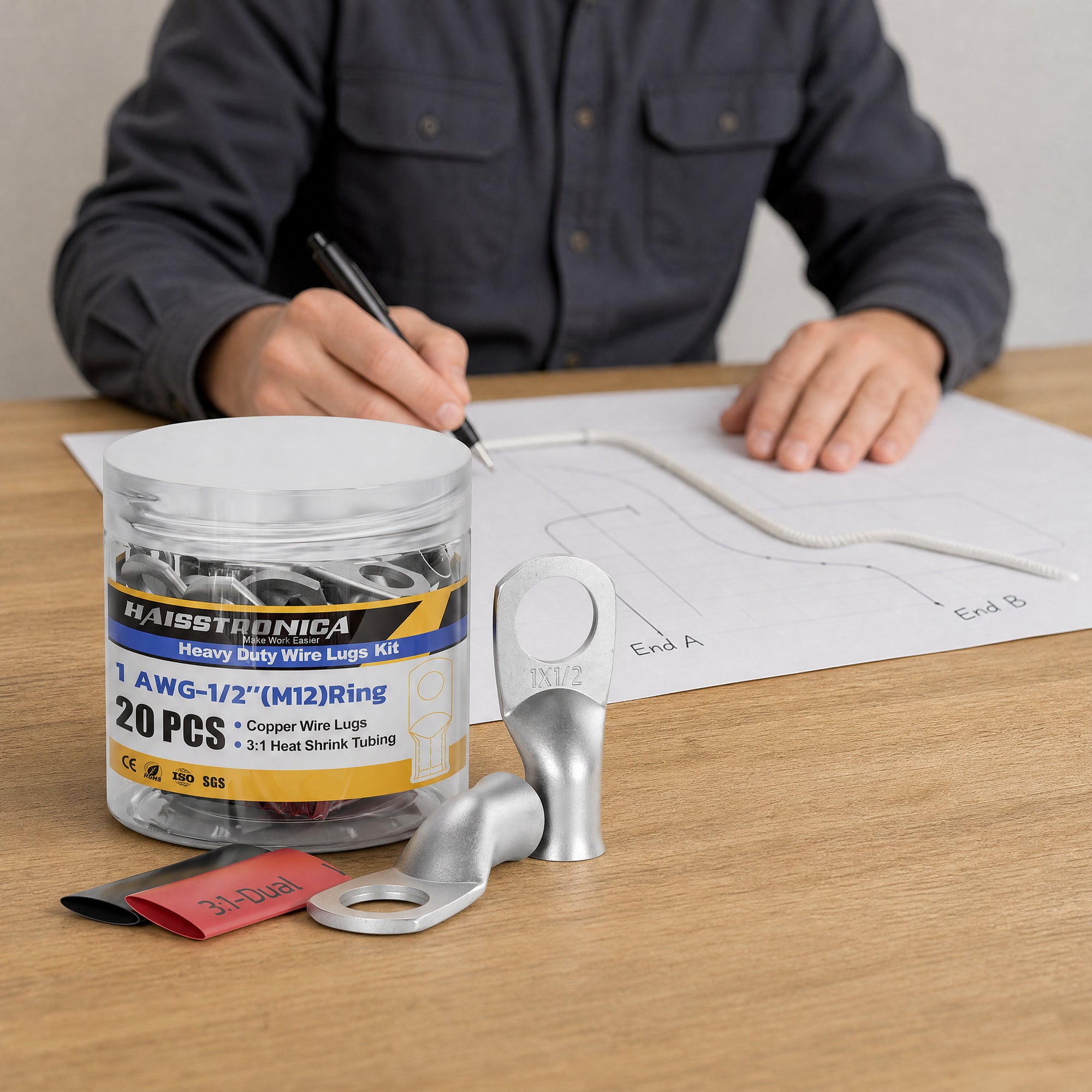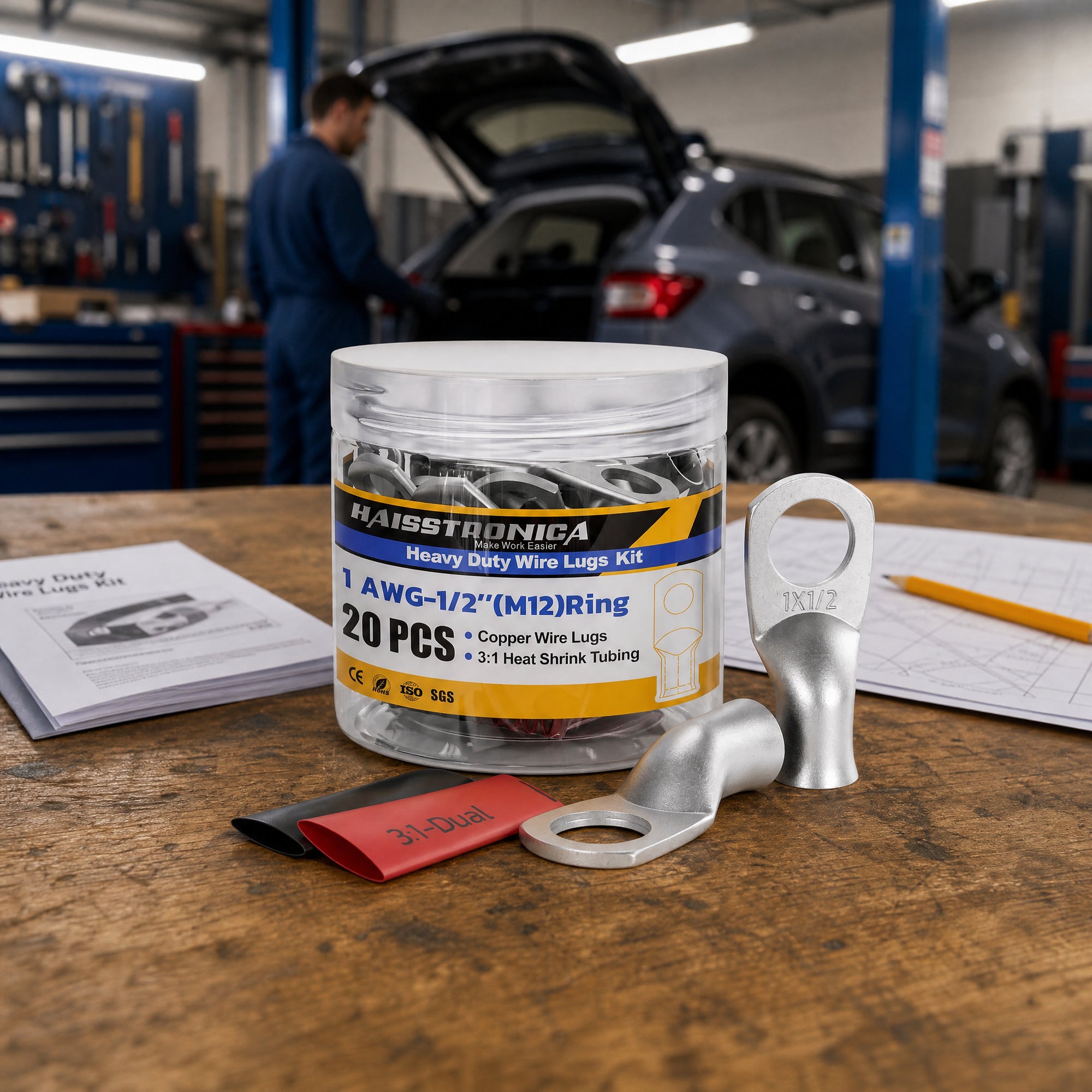

Adhesive-lined heat shrink insulates and seals the crimped lug barrel and cable transition. A terminal boot or stud cover shields exposed hardware—the lug palm, stud, nut, or battery post—from accidental contact. Heat shrink does not replace a cover when conductive hardware remains accessible to tools, panels, or other metal objects.

For example, an auxiliary-battery cable may have red adhesive-lined tubing over its crimped barrel while the ring tongue, stud, and nut remain bare. The sleeve protects the cable end; a suitable boot or equipment cover protects the live bolted connection. Pacer’s battery cable assemblies offer both epoxy-lined heat shrink and boot-covered terminal options.
Before buying either product, confirm the battery or equipment manufacturer’s requirements, the actual lug and cable dimensions, the available clearance, and the service environment. Do not assume that a red sleeve or rubber cap makes an otherwise incompatible termination acceptable.
Choose by What You Need to Protect
Compare battery terminal boots vs heat shrink by the exposed area and failure mode. Adhesive-lined tubing protects the cable termination; stud boots insulate conductive hardware. Use the table to identify which zone needs protection.
| Installation condition | Usually consider | Still verify |
|---|---|---|
| Crimped lug barrel needs insulation and moisture sealing | Adhesive-lined heat shrink | Expanded/recovered diameter, temperature range, material compatibility |
| Positive stud, lug palm, or nut remains exposed | Terminal boot, stud cover, or equipment cover | Stud/terminal geometry, cable exit, full coverage, service access |
| Both barrel and live hardware are exposed | Heat shrink plus a suitable boot/cover | Whether both parts fit without interfering with seating or tightening |
| Connection is already enclosed behind a manufacturer-designed insulating cover | Follow the equipment design | Whether extra parts are permitted or would obstruct the cover |
| Tight battery box or starter/alternator connection | Purpose-designed cover may help | Clearance, cable bend, heat, abrasion, maintenance access |
| High-voltage hybrid/EV traction system | Outside this low-voltage DIY guide | Vehicle-specific high-voltage service procedure |
A Direct Product Path for the Crimped Barrel
Haisstronica offers tinned copper ring lugs with 3:1 dual-wall adhesive-lined sleeves for compatible battery cables. Each selected bottle contains ten identical lugs and ten matching sleeves. Select both the conductor AWG and stud-hole size; the tubing covers the barrel and adjacent cable insulation.
What Heat Shrink Protects—and What It Leaves Exposed
Adhesive-lined tubing seals where the cable enters the lug barrel. TE Connectivity’s ATUM adhesive melts during recovery to form an environmental seal; its SCL tubing provides moisture resistance, strain relief, and insulation. 3M EPS-300 likewise provides abrasion and moisture-seal protection for specified automotive and marine applications.
Selected tubing should cover the barrel and overlap intact cable insulation. Any ring tongue, stud, nut, or battery post outside the sleeve remains conductive and needs its own protection assessment.
Heat Shrink Sizing Is Not Only About Shrink Ratio
A 3:1 label describes recovery ratio, not automatic compatibility. The tubing needs an expanded diameter large enough to pass over the selected lug or barrel before heating, and a recovered diameter small enough to conform to the cable insulation. TE and HellermannTyton both publish tubing selection by supplied and recovered dimensions rather than shrink ratio alone.
Material, adhesive, and operating-temperature limits vary by product family. Confirm the specific tubing specifications; a “3:1” label alone does not establish automotive suitability or temperature limits.
Keep the electrical contact face clear. Heat shrink belongs around the termination area it was selected to protect, not between mating conductive surfaces that must seat according to the battery, fuse block, bus bar or equipment manufacturer’s instructions.
What a Battery Terminal Boot Adds
A battery terminal boot or protective cover serves a different geometric purpose: shielding exposed conductive hardware. Blue Sea Systems’ stud-mount insulating boots are designed to insulate conductive posts and studs and are marketed for battery terminals, power posts, bus bars, battery switches, solenoids and automatic charging relays.
Keep tools, jewelry, and other metal objects away from battery terminals to prevent short circuits. CCOHS also recommends inspecting battery cables, connections, covers, and terminal posts during service.
A correctly fitted cover does not replace those safe-working practices, but it can reduce direct access to an exposed conductive point.
When a Boot Is Worth Considering
Consider a boot when energized hardware remains exposed in an engine bay, battery compartment, starter/alternator area, or auxiliary-power installation. Follow any manufacturer requirement for terminal covers. Choose the shape for the actual stud geometry and cable exit direction.
Cable gauge alone does not determine boot fit. Check terminal shape, stud size, cable exit, and clearance. Blue Sea’s M8/M10 stud-mount boot is one product-specific example, not a universal sizing rule.
If a boot cannot fully seat, pushes the cable into an unsuitable bend, prevents the lug from lying flat or blocks proper hardware access, it is not a suitable cover merely because its nominal cable range appears close.
Build the Protection Plan in the Right Order
Do not decide on the boot or heat shrink before confirming the electrical termination.
First, isolate the low-voltage battery system using the vehicle or equipment procedure. Prevent tools and jewelry from bridging connections. This guide does not cover hybrid or EV traction-battery work.
Second, match cable and lug: conductor gauge or metric cross-section, material, strand construction, barrel size, and stud-hole size must suit the application.
Third, confirm the crimp tool and die. For the Haisstronica Battery Cable Lug Crimping Tool Kit, the currently published positions are AWG 8, 6, 4, 2, 1 and 1/0. If the selected cable or lug falls outside that documented range, use tooling intended for the actual termination rather than cutting conductor strands or forcing the terminal into the die.
Fourth, install the heat shrink when the selected lug and environment call for it. Haisstronica’s battery-lug workflow instructs users to slide the tubing onto the cable before lug installation, complete the correct crimp, inspect the termination, and then recover the adhesive-lined tubing over the barrel and cable transition.
Fifth, install the lug on the actual equipment using the hardware order and tightening requirement specified by that battery, terminal, switch, fuse block or other device. Do not invent a universal battery-terminal torque. The protective sleeve or boot should not be trapped between conductive mating surfaces.
Finally, assess exposed studs, nuts, lug palms, and battery posts. Where protection is required, fit a compatible boot, cap, enclosure, or equipment cover without stressing the cable or blocking service.
Common Failure Patterns
Heat shrink stops at the barrel, but the positive stud is still bare. The cable transition may be insulated and sealed, but the exposed bolted connection still requires a separate exposure assessment.
The boot fits the cable but not the installed terminal. A cover that bunches up, leaves part of the stud exposed or interferes with the nut should be re-selected according to actual terminal geometry rather than forced into place.
A cover cannot fix the wrong lug, damaged conductor, incorrect crimp, dirty mating surfaces, or unsuitable hardware. Inspect the termination before covering it.
Loose recovered tubing may not provide the intended seal. Check the specified recovered diameter and cable fit rather than assuming the shrink ratio guarantees compatibility.
A heat source damages surrounding material. Follow the tubing manufacturer’s heating instructions and use controlled heating equipment; heat-shrink manufacturers describe controlled heat application rather than improvising with open flame around an electrical termination.
Do You Need Both?
Both may be useful in exposed installations: heat shrink protects the barrel and cable transition; a fitted boot protects the remaining hardware. Pacer’s manufactured assemblies demonstrate this arrangement.
But “always use both” would be too broad. A factory battery enclosure, fuse-block cover, insulated distribution block or OEM terminal assembly may already provide the required physical barrier. Conversely, an exposed positive stud can still need a cover even when the crimp barrel is properly sealed. Selection must follow the actual battery, vehicle and equipment design.
Can Ordinary Single-Wall Heat Shrink Replace Adhesive-Lined Tubing?
No. Adhesive-lined tubing bonds around the substrate during recovery to improve moisture sealing. Ordinary single-wall tubing does not automatically provide the same environmental protection.
Should the Boot Cover Only the Positive Terminal?
Prioritize exposed positive hardware because contact with grounded vehicle metal can cause a short circuit. Protection still depends on the equipment design and all exposed-conductor hazards. Boots may also protect starters, alternators, bus bars, and power posts.
Does Heat Shrink Make a Battery Lug Waterproof?
Do not describe the whole connection as universally “waterproof.” Properly selected adhesive-lined tubing can provide moisture sealing over the region it actually covers, but it does not seal an exposed ring face, stud, nut or battery post. TE, 3M and Haisstronica all describe environmental sealing around the sleeve area rather than converting the entire bolted connection into a sealed enclosure.