
There is no universal safe number.
There is no universal number of cable lugs that is safe to stack on every battery terminal. The correct limit depends on the battery or equipment manufacturer, the terminal design, bolt or stud engagement, lug thickness, required torque, and whether the completed connection can still sit flat and remain protected.

Check cable-lug options →
For a simple vehicle installation with one starter cable and one properly approved auxiliary connection, stacking may be acceptable when the battery manufacturer permits it and the complete hardware stack still meets its installation instructions. Once several accessories begin converging on one battery post, a properly rated busbar or distribution point usually makes the system easier to connect, protect, inspect, and expand.
That distinction matters when adding an inverter, DC-DC charger, auxiliary fuse block, audio amplifier, compressor, lighting system, or other vehicle accessory. The question is not simply whether another ring terminal will physically fit over the stud. The question is whether the entire electrical and mechanical connection remains appropriate after that lug is added.
1. Quick Decision: Stack Another Lug or Install a Busbar?
| Your installation | What to consider | What still needs to be verified |
|---|---|---|
| One existing heavy cable plus one additional approved cable | Stacking may be reasonable | Battery manual, bolt/stud engagement, torque, lug seating, cover clearance |
| Two or three accessory cables already sharing the terminal | Reassess before adding another | Manufacturer limit, hardware height, cable strain and protection |
| Several accessories will be added now or later | Consider a busbar/distribution point | Busbar current rating, stud size, insulation, feed cable and circuit protection |
| Terminal cover no longer closes | Redesign the connection | Do not leave an exposed positive stack simply because it electrically fits |
| Correct bolt no longer reaches adequate thread engagement | Do not force the original hardware | Use only hardware allowed by the battery/equipment manufacturer |
| Lugs no longer lie flat | Stop adding terminals | Change the distribution layout |
| Multiple parallel batteries or multiple large DC loads | Busbar architecture is often worth evaluating | Equal-current paths, cable sizing, fusing and equipment instructions |
Why “four lugs maximum” is not a universal automotive rule
You may encounter a common statement that no more than four ring terminals should be placed on one stud.
If the answer is unclear, do not choose a longer bolt simply because it threads in. Insert terminals have defined thread diameter, pitch and depth.
2. The Lug Closest to the Terminal Needs a Clean, Flat Contact Surface
Electrical terminal hardware is not simply a pile of metal held together by a nut. The connection depends on controlled clamping pressure across conductive surfaces. Battery and power-equipment manufacturers commonly instruct installers to place the cable lug directly against the designated terminal surface rather than putting a washer between the lug and the electrical contact surface.
Do not turn that principle into a homemade universal stacking order such as “largest cable must always be first” unless the relevant manufacturer says so. The correct stack-up, washer arrangement and torque belong to the terminal design being used.
3. When a Busbar Becomes the Better Architecture
A busbar becomes especially attractive when the battery terminal is turning into a distribution point rather than simply a battery connection.
The exact fuse locations, conductor sizes and busbar current rating depend on the vehicle, loads and applicable installation requirements; they should not be inferred simply from the busbar’s number of studs. Busbars also help when several high-current devices need comparable electrical paths.
For parallel battery systems, the need can become even clearer. Discover Battery’s installation manual states that systems with five or more batteries in parallel should use a busbar configuration and that the battery cable sets should be equal in length in that arrangement. That is a manufacturer-specific requirement rather than a universal five-battery threshold, but it demonstrates why distribution architecture should follow the actual battery documentation.
Five warning signs that your battery terminal is becoming a bad distribution block
The terminal hardware is running out of useful engagement. If adding another lug leaves insufficient thread engagement or prevents the specified nut or locking feature from working as designed, stop and check the manufacturer’s hardware requirements. Longer hardware is appropriate only where the battery manufacturer allows it.
The lugs will not remain flat. Offset barrels, thick palms and cables approaching from different directions can create a springy or uneven stack. Battle Born warns that excessive stacking can compromise contact quality, while its installation guidance emphasizes even, aligned connections.
The terminal cover cannot be restored. Positive distribution hardware should remain protected against accidental shorts. Blue Sea’s busbars use insulating covers specifically to protect connected conductors from shorting, highlighting why exposed distribution points need appropriate protection.
Every new accessory requires disturbing the main battery connection. A dedicated distribution point allows branch circuits to be serviced without repeatedly rebuilding the principal battery-terminal stack. Blue Sea’s guidance on organizing growing battery wiring specifically moves those additional connections to a busbar.
The system now has several high-current branches. At that stage, cable sizing, branch protection, distribution hardware and serviceability deserve to be designed together rather than treating the battery post as an unlimited junction point. Victron and Fortress both describe busbars in multi-device battery distribution systems for this reason.
4. Match the Cable Lug Before You Choose the Crimping Tool
Whether the cable ends at a battery terminal or a busbar, the ring lug still has to match both the conductor and the stud.
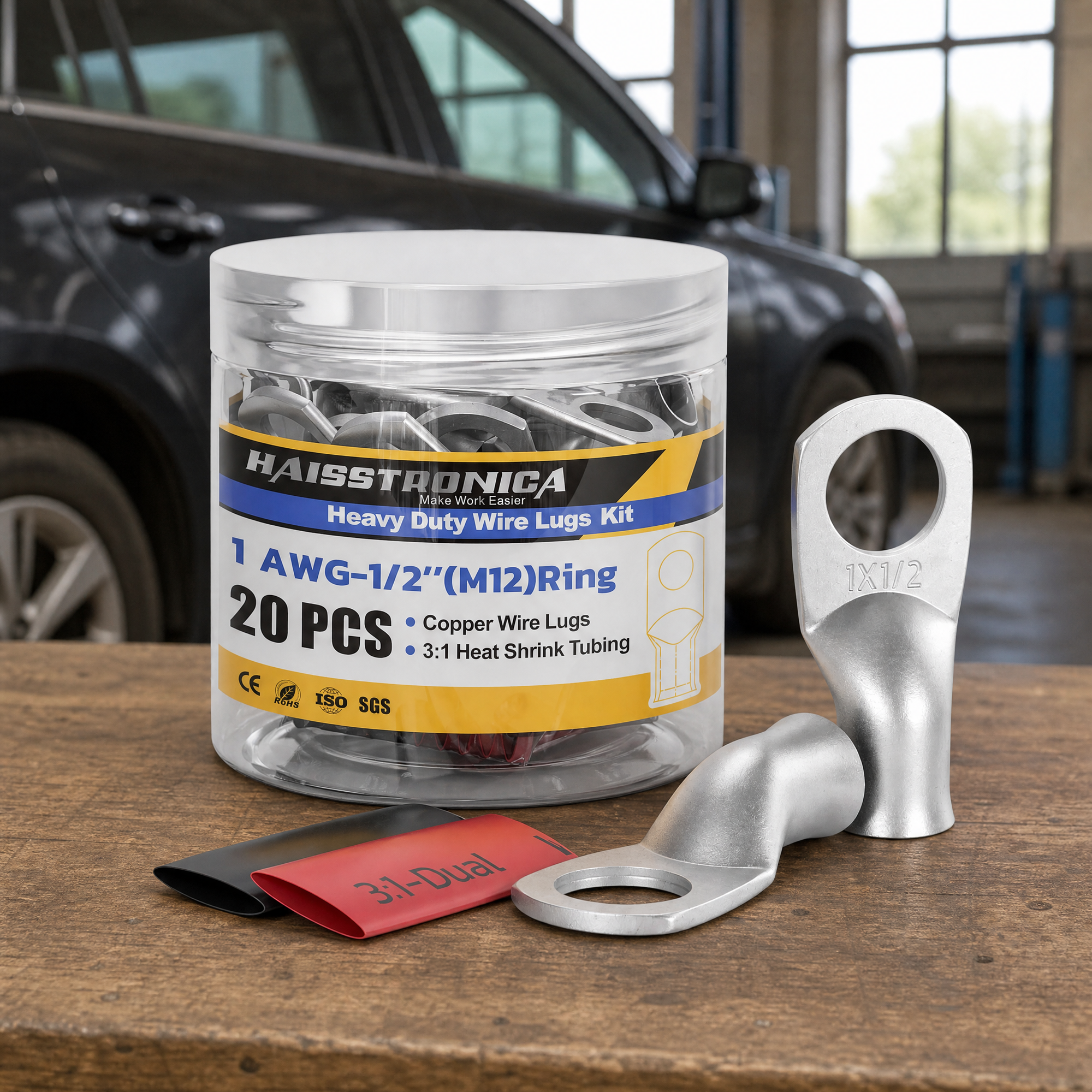
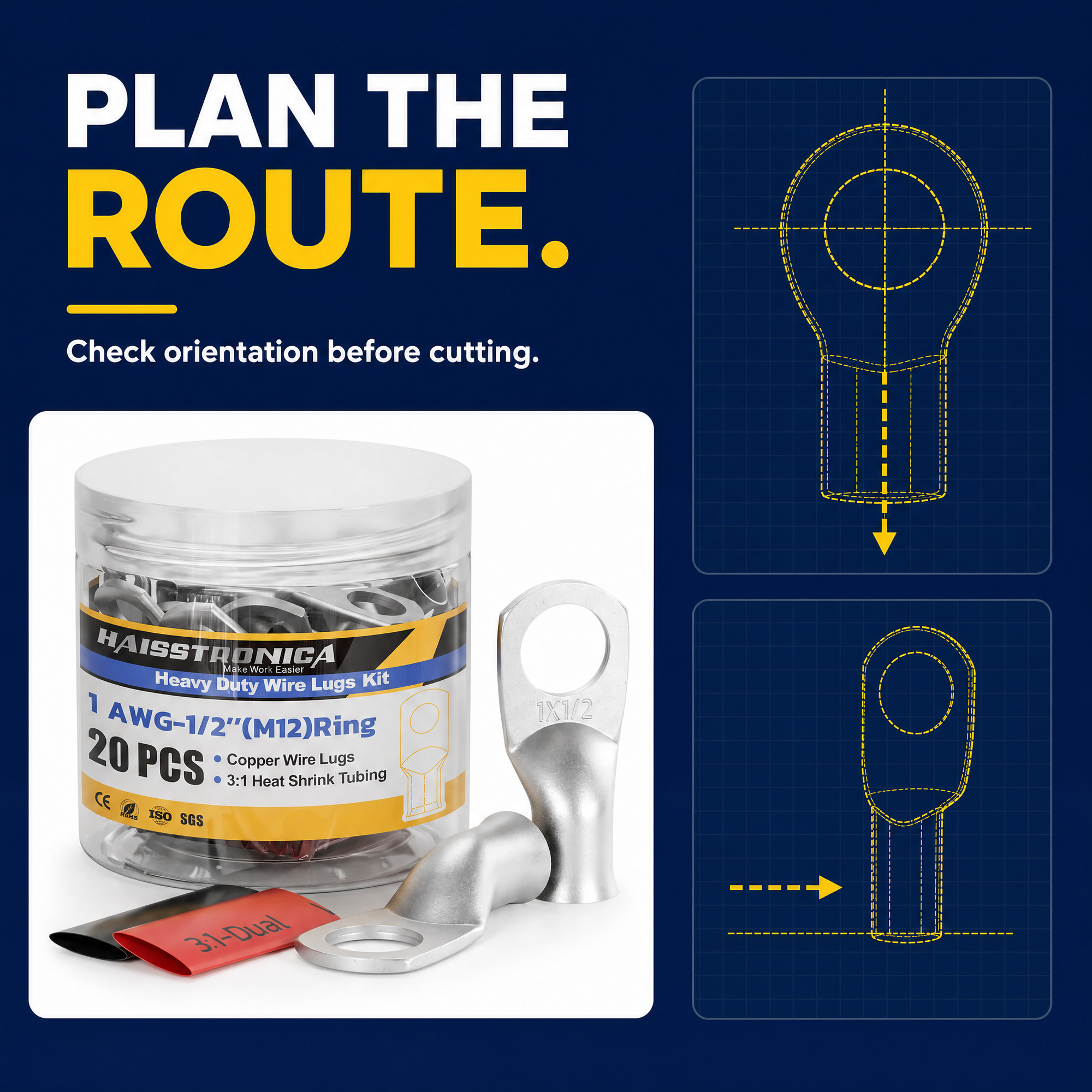
Haisstronica’s tinned battery cable lug range separates cable AWG from stud-hole size. Its current product listing includes lugs from 8 AWG through 4/0 AWG with different available hole sizes depending on the cable gauge. A lug that accepts the cable but has the wrong hole is not the correct terminal, and drilling a smaller ring hole larger changes the manufactured part rather than establishing compatibility.
For installers working with compatible 8, 6, 4, 2, 1 and 1/0 AWG copper battery lugs, Haisstronica’s Battery Terminal Crimper uses six rotating hex-die positions. The product documentation says the lug barrel and cable conductor must both match the selected size and that the lug’s required crimp profile still needs to be checked. The tool does not cover every battery lug simply because its ring hole fits the battery or busbar stud.
For larger 2/0–4/0 cable, Haisstronica’s own battery-lug installation guide tells users to move to tooling explicitly rated for those larger conductors rather than forcing the AWG 8–1/0 crimper beyond its stated range.
5. Plan the Connection Before Making New Cables
First, isolate the battery system according to the vehicle, battery and accessory manufacturers’ procedures. Avoid placing conductive tools across battery terminals, and do not work on an energized connection simply to test whether an extra lug will fit. Battery manufacturers warn that loose, over-tightened or improperly installed terminal connections can lead to overheating, terminal damage or fire.
Next, list every cable that currently terminates at the battery and every circuit you plan to add. Record each conductor size, ring-hole size, expected current path, circuit protection and destination. Then compare that list with the terminal manufacturer’s permitted hardware stack.
Inspect the proposed stack before crimping new cables. Confirm that each ring can lie flat, that the approved fastener can still engage correctly, that the specified torque can be applied with the available tool, that the cables are mechanically supported rather than pulling sideways on the battery terminal, and that the protective cover can be restored. Battle Born specifically notes that vehicle and marine vibration make secure, supported battery connections important over time.
If those conditions cannot be met cleanly, stop solving the problem with a taller stack. Select a busbar or other approved distribution solution rated for the system instead.
Frequently Asked Questions
Can I put two ring terminals on one battery stud?
Possibly. Some battery manufacturers explicitly accommodate multiple lugs, sometimes with different approved hardware. Check the battery’s instructions, terminal geometry, bolt engagement, required torque and final protection before doing so.
Can I stack three or four battery lugs?
Do not choose the number from a generic rule alone. Four terminals per stud is an ABYC recommendation cited by Blue Sea Systems for marine systems, not universal permission for every battery. Your battery or equipment instructions remain the first authority for the particular terminal.
Should the biggest cable lug go on the bottom?
Do not assume a universal “largest-first” rule. Follow the actual equipment’s specified terminal stack. The consistent requirement across several manufacturers is that the intended electrical contact surface remains clean and properly clamped and that washers are not inserted where the manufacturer says the lug should make direct contact.
Does a busbar increase the amount of current my battery can supply?
No. A busbar is a distribution component; it does not increase the battery’s electrical capability. The busbar, feed conductor, branch conductors, protection devices and connected loads all still need to be appropriately rated for the actual system.
If you have only a small number of approved connections and the battery manufacturer allows the complete stack, stacking lugs can be workable. If the terminal is becoming crowded, the hardware no longer fits as specified, the cover cannot close, or several branch circuits need clean distribution, treat that as a design signal to evaluate a properly rated busbar instead.
For the cable ends themselves, select the conductor gauge and stud hole first, then verify the crimp profile and tooling. Haisstronica’s heavy copper lugs and AWG 8–1/0 battery crimper can support compatible cable fabrication, but they do not determine how many terminals your battery manufacturer permits on one post.

Review crimper specifications →
Related Guides
For fabrication, see Haisstronica’s battery cable lug crimping guide. For a hot existing terminal, use the separate battery terminal overheating diagnostic guide. Those pages address installation and troubleshooting rather than the distribution decision covered here.